
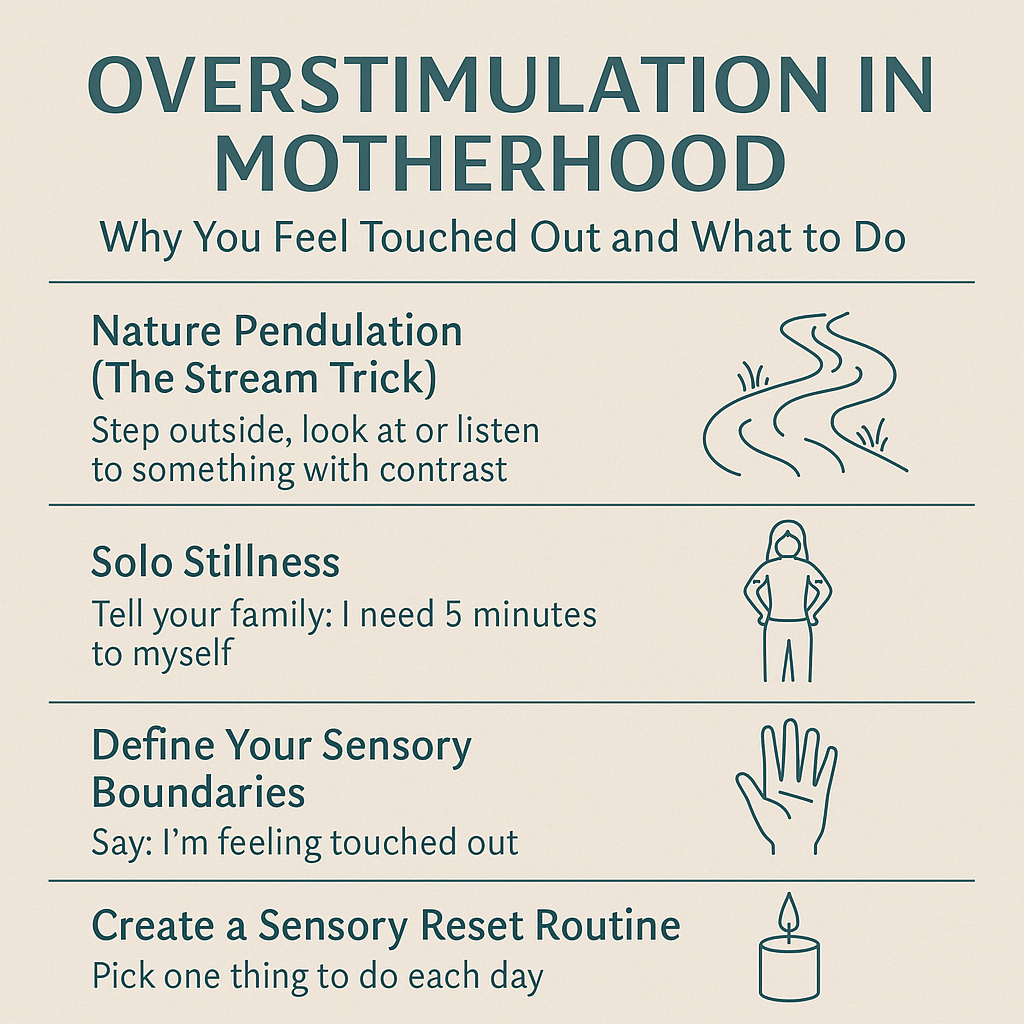
Why You Feel So Overstimulated as a Mom
You love your kids. And yet sometimes, you just want everyone to stop touching you. Stop asking. Stop climbing.
If you’ve ever fantasized about silence or felt unreasonably irritated by snack wrappers or constant questions, you might be experiencing overstimulation—a common and often unspoken part of motherhood.
Overstimulation occurs when your nervous system receives more sensory input—touch, sound, visual clutter—than it can process. Mothers are especially vulnerable because:
- We’re often touched all day (nursing, co-sleeping, carrying, soothing)
- We rarely have quiet—there’s always a sound, a need, or a decision to be made
- We carry the invisible weight of anticipating everyone’s needs, which drains cognitive and emotional resources
What Being “Touched Out” Really Feels Like
Many moms describe it like this:
- “I flinch when my partner tries to hug me at the end of the day.”
- “I love my kids, but I want to lock myself in the bathroom.”
- “I feel rage over the smallest things, and then guilt right after.”
- “My skin feels itchy even when no one’s touching me.”
This isn’t a sign that something is wrong with you—it’s a sign your nervous system is maxed out.
What Helps: How to Reset an Overloaded Nervous System
Instead of powering through or blaming yourself, the key is to create moments of calm and regulation. Here are four simple, sensory-friendly practices that can help:
1. Nature Pendulation (The Stream Trick)
Step outside, even for three minutes. If you can, look at or listen to something that contains both movement and stillness—like a stream that flows both fast and slow.
Let your eyes gently shift between the rushing and the calm. This technique, called pendulation, helps your nervous system practice moving between intensity and rest.
Tip: If you can’t get outside, try watching a short video with natural contrasts, like rain or water patterns. There’s a recent one for you on our @GuidedinNature Instagram account.
2. Solo Stillness
It’s not selfish to need space.
Try saying: “I need five minutes to myself so I can come back grounded.” Step outside, close the door, stand barefoot if you can, and take three deep breaths. Let your body and mind slow down.
Stillness restores your ability to connect.
3. Define Your Sensory Boundaries
You are allowed to say: “I’m feeling touched out right now.”
You can love your family deeply and still need physical and mental space.
A gentle script:
“I need a moment without touch right now. I’ll be ready to snuggle again soon.”
Even young children can begin to understand this language, especially if modeled calmly and consistently.
4. Create a Sensory Reset Routine
Choose one thing to do daily to empty your sensory cup before it overflows.
Examples include:
- Listening to natural soundscapes or white noise
- Stepping outside and noticing three things you can hear
- Staring at a candle flame for one quiet minute
- Humming or smelling a grounding scent
- Sitting under a weighted blanket with eyes closed
It doesn’t need to be elaborate—just intentional.
You’re Not Broken. You’re Overstimulated.
This isn’t about being weak or “not enjoying motherhood enough.”
This is about sensory overload in a societal culture that doesn’t make space for mothers to simply be human. You don’t need to do more. You need more support, silence, and regulation.
Ready to Find Your Reset?
I help mothers unwind from overstimulation and find steadier ground through one-on-one nature-based therapy. Whether you’re postpartum, in the toddler trenches, further along in your motherhood journey, or somewhere in between, we can build a plan that meets your nervous system where it is.
Email me at lauren@guidedinnature.com to schedule your free consultation.
You can also join our Flourish in Motherhood gatherings for seasonal, nature-informed community support. Late summer and fall gatherings coming soon. Stay tuned!